.gif)
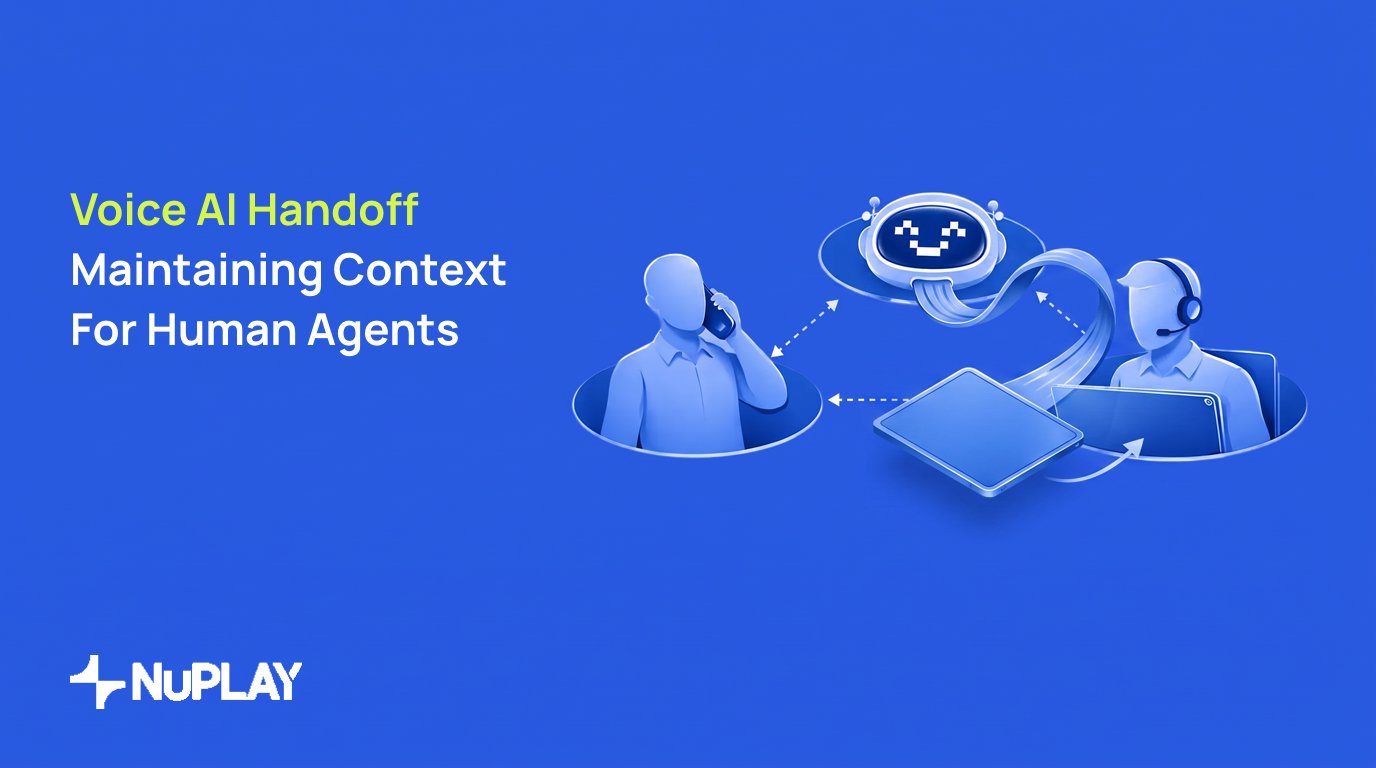

Voice AI human handoff is the transfer of an ongoing interaction from an agent to a human operator. In 2026, 87% of customers demand an immediate path to a human agent when dealing with automated systems. Effective handoffs preserve the full conversation history, user details, and workflow state, ensuring the customer never has to repeat themselves.
Enterprise leaders running high-volume workflows face a critical challenge. When an automated system hits a limitation, the transition to human support often destroys the customer experience. Understanding how context transfers smoothly helps leaders reduce friction and maintain continuity. This guide explains the process from core principles to practical implementation. NuPlay AI runs enterprise workflows in production and improves them after every run through a closed feedback loop. We will explore how treating every handoff as a diagnostic event strengthens the entire system.
What is Voice AI Human Handoff
Voice AI human handoff refers to the transfer of an ongoing interaction from an agent to a human operator. The process must preserve full conversation history, user details, and workflow state. Service organizations are entering a period where AI and human expertise must work in tandem to create valuable service experiences.
In 2026, effective handoffs are a requirement for production-grade systems in retail, insurance, and financial services. A blind transfer where the human asks, "How can I help you today?" is unacceptable. NuPlay AI's NuPro task-specific micro-agents execute the voice interaction and detect escalation triggers natively. They package verified identity, intent, and attempted actions into a usable state for the human operator.
How Voice AI Human Handoff Works
Context is captured across organizational, agent, and user tiers before transfer occurs. The system detects escalation triggers such as low confidence scores, detected emotional distress, or explicit user requests. It then packages relevant data for the human. Handoff completes with the human receiving a summarized view plus full underlying records.
The handoff is the unit of evaluation in orchestrated systems. You must monitor the fidelity of state transfer to prevent role drift in production. One major hurdle is memory bloat. Agents often degrade during long calls not due to model failure, but due to context accumulation. To solve this, advanced systems use context compaction during handoff. This ensures the human receives only the strategic essence of the call, driving a 43% improvement in comprehension for the receiving operator.
NuContext provides the tiered memory structure required to package context for human operators without data loss. It bridges the gap between the agent's memory and the human's interface.
Key Concepts and Terminology
Understanding the terminology clarifies how these systems operate. The context layer maintains memory across sessions and agents. Agent mode, automated mode, and human mode define how work is routed. The pitch is moving the right work into agent mode rather than replacing people entirely.
A closed-loop improvement system captures every handoff outcome to refine future routing decisions. NuPulse monitors handoff rates and outcomes in real time to ensure service level agreements are met during high-volume periods.
Approve-to-promote is a vital governance pattern. When the system proposes a fix to reduce unnecessary handoffs, that change must be validated by a human before deploying to production. This ensures compliance with standards like ISO/IEC 42001:2023, which mandates human accountability in automated workflows.
Enterprise Use Cases and Examples
Insurance claims require precision. Complex cases move from agent to specialist without repeating information. A claimant might report an accident via voice. The agent collects the details, verifies the policy, and hands off to an adjuster. The adjuster receives the full transcript and policy data instantly.
Collections workflows escalate to human agents while retaining payment history and customer sentiment. If a caller becomes frustrated during a payment negotiation, the agent detects the sentiment shift and transfers the call to a specialized retention team. The human agent sees exactly what payment plans were already offered.
Mortgage and home services interactions require human review for compliance or exceptions. In both, the escalation path is the control. The agent completes what policy allows it to complete, then routes the rest to a person with the full interaction state attached, so the customer does not repeat themselves at the handover.
Benefits of Seamless Context Transfer
Seamless transfer reduces customer effort by eliminating repeated explanations. Currently, 74% of consumers find it frustrating to repeat their story to different agents. Memory-rich AI eliminates this friction.
It improves first-contact resolution even when human involvement is required. It supports the governed movement of work between agent and human modes. By 2026, the divide in enterprise AI is between organizations that ship static pilots and those that build infrastructure for continuous, governed improvement. If a system cannot diagnose its own handoff failures, it is a liability.
While many enterprises pilot AI handoffs, an 88% pilot failure rate persists due to context fragmentation and a lack of infrastructure for governed, run-over-run improvement.
Common Misconceptions About Voice AI Human Handoff
Handoff does not require starting over when proper context architecture is in place. Many buyers assume a transfer means a dropped call or lost data. With modern protocols, state transfer is instantaneous and complete.
Human involvement remains the default for complex decisions with approve-to-promote controls. Static handoff rules lose effectiveness quickly. Agentic drift causes a projected 42% reduction in task success rates within months, making static rules operationally unacceptable.
Voice serves as one interaction channel rather than the defining feature of the platform. Voice is proof of execution capability. If a platform can handle the latency and context demands of a live voice handoff, it proves the underlying orchestration is sound.
How NuPlay Supports Context-Aware Handoffs
NuPlay treats every handoff as a data point. Instead of seeing handoff as a failure, the system uses it to diagnose coverage gaps. NuLoop records handoff outcomes and proposes validated improvements through its Report, Diagnose, Propose, Try, Ship process.
Using the Model Context Protocol, agents hand off state to any compliant human-facing tool without custom API debt. This standardized connection reduces integration time and prevents data loss during the transfer. This architecture drives an 83% reduction in research cycles for agents receiving the escalated calls.
Here is a comparison of static transfers versus context-aware orchestration.
Conclusion
Effective voice AI human handoff depends on structured context management and governed improvement loops that keep enterprise workflows continuous and reliable. Static deployments degrade as the business changes, leading to broken transfers and angry customers. NuPlay runs enterprise workflows in production and improves them after every run through NuLoop. By keeping agents, the systems they operate, and the context they draw on under one platform, enterprises can ensure every handoff adds value. Book a demo to see how governed orchestration protects your customer experience during critical escalations.