.gif)

Disclosure: NuPlay AI builds an enterprise agentic AI platform. This article is based on Intercom's public documentation, product pages and published user reviews, not on hands-on testing.
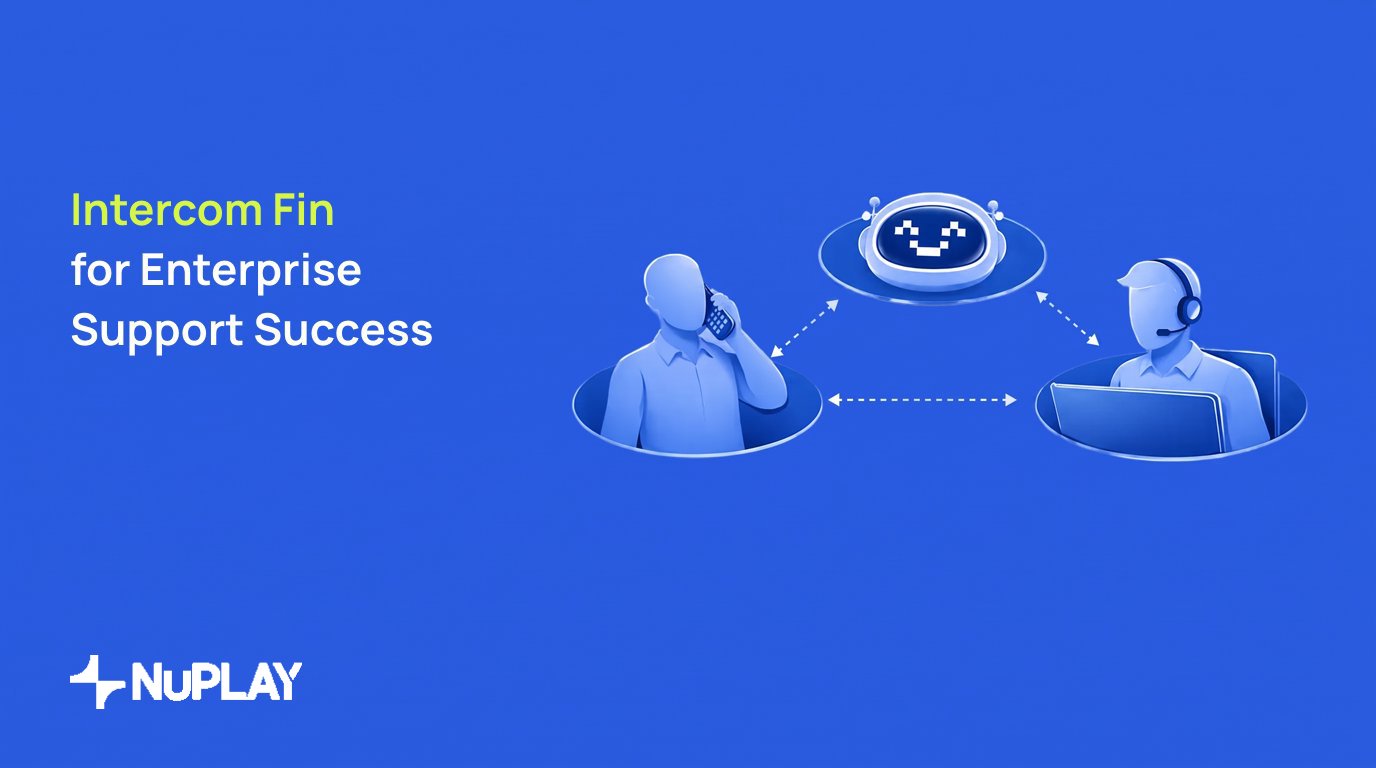
Intercom Fin is an AI agent that integrates into the Intercom helpdesk to resolve inbound inquiries. It functions as a first-line filter, answering standard tier-one questions using existing knowledge base documentation before routing complex issues to human support teams.
Enterprise teams evaluating AI support tools need clarity on where specific agents deliver value and where they require additional layers. Support volumes in large organizations demand precision. When deploying AI within a system of record, leaders must understand exactly what the tool can handle and where it breaks down.
This guide explains the core functions of the agent and its practical boundaries in complex support environments. You will gain a clear framework for assessing fit within production-grade workflows.
What Is Intercom Fin?
Intercom Fin is an AI agent designed to handle customer inquiries directly within the Intercom platform. It focuses on resolving common support tickets through automated responses generated entirely from an organization's existing documentation.
The system operates inside existing helpdesk workflows rather than as a standalone enterprise platform. It answers common questions by pulling info from your help center or knowledge base, acting as an intelligent retrieval system. When a customer asks a question, the agent searches the provided text, extracts the relevant facts, and formulates a conversational reply.
This approach keeps implementation straightforward for teams already using the incumbent helpdesk. It requires no new software installation. However, it also means the agent remains strictly confined to the information explicitly written in the help articles.
How Intercom Fin Works
The underlying mechanism relies on intent detection and semantic search. Fin draws from knowledge base articles and past conversations to generate replies. It reads the customer's message, identifies the core request, and matches it against approved support content.
Responses are generated in real time but remain limited to predefined training data. If a customer asks about a return policy, the agent finds the return policy article and summarizes it. If the policy recently changed but the article remains outdated, the agent confidently delivers the outdated information.
The tool natively supports six messaging channels, including SMS and WhatsApp. It uses intent detection to route or answer queries without human intervention across these touchpoints. When it encounters a question with no corresponding documentation, it triggers a fallback protocol and transfers the chat to a human representative.
Key Concepts and Terminology
Evaluating an AI support deployment requires standardizing how you measure success and failure. The following table outlines the core metrics used to assess agent performance.
Resolution rate serves as the primary indicator of effectiveness. Resolution rate depends on how complete the knowledge base is and how strict the handover rules are, so measure it on your own ticket mix before committing. Even a well-maintained deployment leaves a share of conversations for human attention.
Knowledge base coverage directly impacts this resolution metric. If your documentation only covers 40% of customer issues, your resolution rate will never exceed 40%. Handover thresholds act as the safety net. You define these thresholds to ensure sensitive topics bypass the AI entirely.
Enterprise Support Use Cases
Large organizations deploy this agent primarily to deflect repetitive, low-complexity volume. Fin handles high-volume tier-1 questions such as order status updates, password resets, and basic policy inquiries.
It supports retail and financial services teams managing repetitive customer requests. For example, retail customers frequently ask for shipping timelines. The agent retrieves this data instantly, preventing a human from spending three minutes on a trivial lookup. Customers get an answer immediately instead of waiting in a queue.
Integration with existing inboxes allows deployment without new infrastructure. In financial services, how much time this saves depends on how deeply the agent is integrated with the claims and account systems behind it. The agent handles the initial data collection, verifying the customer's identity and the nature of the claim, before passing a neatly summarized ticket to a specialized human handler.
Benefits and Importance
Understanding the specific benefits of this tool helps justify the investment. Organizations reduce response times for straightforward inquiries from hours to seconds. This immediate gratification improves customer satisfaction scores while lowering the overall cost per contact.
Support teams can focus human agents on complex or high-value interactions. When an organization clears the queue of password resets, human representatives have the time to handle delicate retention calls or complex technical troubleshooting. This shift in workload is why 85% of customer service leaders planned to explore or pilot customer-facing conversational generative AI in 2025, according to a Gartner survey.
The operational impact is tangible. As industry experts note, the tool clears real tier-one volume for teams with maintained content. However, clear boundaries help prevent over-reliance on the tool in changing business conditions. Buyers must also consider the commercial structure, as pricing and feature availability are tightly bundled into granular helpdesk tiers, which can restrict advanced automation capabilities to high-cost plans.
Where Intercom Fin Stops Short
While effective for basic retrieval, the agent faces strict limitations in production environments. Fin cannot execute multi-step workflows that require cross-system changes or approvals. It operates as a conversational interface over text, not as an integration layer for enterprise databases.
If a customer needs to change a flight, update a billing address across three legacy systems, or request a refund that requires managerial approval, the agent stops. It lacks the deep API orchestration required to perform these actions. To solve this, platforms like NuPlay use components like NuStack to orchestrate the workflow, making enterprise systems agent-ready by building or wrapping existing infrastructure.
Furthermore, the tool lacks built-in mechanisms for continuous improvement after each interaction. It is a static deployment. When a business process changes, the agent continues giving old answers until a human manually identifies the gap, writes a new help article, and publishes it. A July 2026 Gartner Peer Insights review of Intercom Fin specifically flags limited procedure visibility and the lack of conversation simulation as barriers to scaling the deployment.
NuPlay runs enterprise workflows in production and improves them after every run through NuLoop, with agents, the systems they operate, and the context they draw on under one platform. This closed feedback loop watches every run and ships validated fixes back into the system through a governed process of Report, Diagnose, Propose, Try, and Ship. Every change requires human sign-off through an approve-to-promote model. Static systems like Fin lack this diagnostic cycle, forcing support managers to manually hunt for failure points.
Complex or policy-driven decisions still require human oversight. The agent cannot reason through edge cases or apply discretionary logic to a customer's unique situation. It simply matches text to text.
Common Misconceptions
Many assume the agent operates autonomously across all support scenarios. In reality, it functions strictly within the guardrails of its provided documentation. If the answer is not explicitly written down, the agent cannot help.
Users may expect ongoing performance gains without additional configuration. This is a critical misunderstanding of static AI deployments. The system does not learn from its mistakes automatically. If it fails to answer a question on Monday, it will fail to answer the exact same question on Friday, unless a human administrator intervenes to update the source material.
The tool is sometimes viewed as a complete replacement for human staff rather than a first-line filter. Enterprise workflows always require a mix of Human, Automated, and Agent modes. The goal is moving the right work into agent mode, not replacing the people required for empathy, complex problem-solving, and final approvals.
Conclusion
Intercom Fin provides a reliable method for answering basic customer questions using existing documentation. It integrates easily into its native helpdesk and successfully deflects repetitive, low-value inquiries, freeing human agents to focus on complex tasks.
However, its capabilities stop at information retrieval. It cannot execute complex transactions across multiple backend systems, and it relies entirely on manual updates to maintain its usefulness. Understanding both the reach and the boundaries of this tool enables better decisions about when to layer additional enterprise capabilities. For organizations managing high-volume, dynamic workflows, transitioning from a static deployment to a self-improving platform ensures that automated support actually scales with the business. Talk to the team to see how governed, closed-loop improvement changes enterprise operations.