.gif)
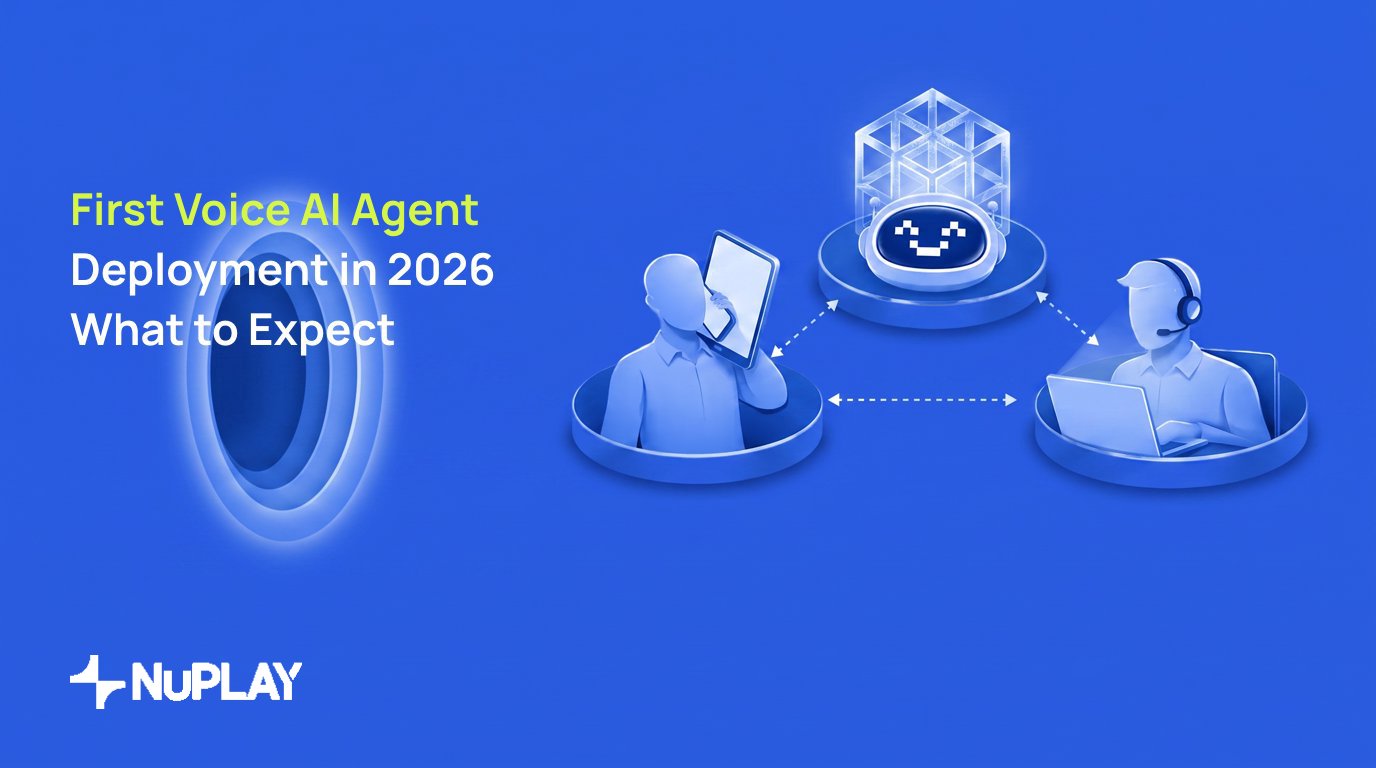

A first voice AI agent deployment is proof of production readiness, not a standalone voice project. If an agent can hold a live, multi-turn voice interaction, it has shown it can orchestrate the underlying back-office workflow. What to expect depends on integration, governed change, and measurable shifts across human and agent modes.
NuPlay AI runs enterprise workflows in production and improves them after every run through NuLoop. This ensures that initial deployments do not degrade over time. By keeping agents, the systems they operate, and the context they draw on under one unified platform, organizations can scale with confidence. This guide explains exactly what technical and operational shifts to expect when launching your first production-grade voice agent.
Current State of Enterprise Agent Deployments
Early voice deployments in banking, financial services and insurance have matured into high-volume repeatable workflows in collections and mortgage processing. However, the shift from pilot to production-grade requirements exposes a massive execution gap across the industry.
Roughly 88% of agent pilots fail to reach production organization-wide due to governance friction and model reliability issues. Most pilots fail because they are built as static point solutions. Without a platform that includes a dedicated build layer and an improvement loop, systems cannot handle the operational realities of enterprise data.
The canonical AI agent benchmark is a lie of omission. It tells you how the agent performs in the pilot, not whether it still performs after go-live, as evaluation experts warn. Production agents exist in a world of constant background change. This phenomenon is known as agentic drift. Agentic drift steadily reduces task success rates and increases human intervention within months of deployment.
To combat this degradation, enterprises demand platforms that handle deep integration and context preservation. NuPro task-specific micro-agents handle the execution of high-volume repeatable workflows natively within the Astra and SEAL models. This approach isolates tasks to prevent system-wide degradation.
Integration and System Readiness
Traditional software models fail in enterprise AI because organizations require deep integration with sensitive data. Standard platforms cannot handle this without elite engineering support, a challenge often called the SaaS customization paradox. First deployments succeed only when legacy systems are rebuilt or wrapped to be completely agent-ready.
NuStack makes legacy systems agent-ready by building, wrapping, or rebuilding them to orchestrate end-to-end workflows. This build layer connects the execution models directly to your underlying databases and customer relationship management tools. Recent technical updates, such as the addition of remote Model Context Protocol and SIP support to real-time API infrastructure, make these deep integrations highly standardized.
Beyond basic connectivity, establishing tiered memory is non-negotiable for a successful rollout. NuContext provides the essential memory tiers across Organizational, Agent, and User data to maintain context in multi-turn interactions. This ensures that when a customer speaks to a micro-agent, the system instantly recalls their policy details, previous chat history, and the specific business rules applying to their account.
Production Monitoring and Feedback Loops
Visibility into live operations dictates the survival of a new deployment. Without real-time status, volume, and outcome tracking, operations leaders fly blind. Security remains a real concern, with most organizations experiencing at least one generative AI-related security breach in the past year. Strict monitoring prevents these vulnerabilities from reaching production. AvePoint's State of AI 2026 report found 89.5% of organizations experienced at least one generative AI-related security breach in the past year, and its own findings point to governance, access controls, and least-privilege management as the fix, not operational monitoring alone. A production-grade deployment needs both: real-time operational visibility to catch broken workflows, and separate security governance to control what an agent can access.
NuPulse provides the real-time status, volume, and outcome dashboard required for operational visibility during the first deployment. It flags anomalies immediately so teams can react. However, monitoring alone does not fix broken workflows. You need a mechanical process to apply corrections safely.
NuLoop acts as the core intellectual property that watches every run and ships validated upgrades back into the other layers. It operates through a governed Report, Diagnose, Propose, Try, and Ship cycle. The system identifies why a workflow failed and proposes a specific fix. Crucially, this process utilizes human approve-to-promote governance on every change. A human operator must sign off before any system update ships to production, ensuring complete enterprise control over the agent's behavior.
What happens if something goes wrong after go-live? Approve-to-promote governs planned improvements, but a first deployment also needs a clear rollback path for the unplanned kind - a bad config push, an integration change on the customer's side, or a spike in escalations. Define who can pull an agent out of production, how fast that can happen, and what the fallback path is (typically, routing to a human queue) before the first live call, not after an incident.
Industry-Specific Workflow Shifts
The impact of moving work into agent mode varies by sector, but the efficiency gains are universally measurable. In retail and home services, back-office automation handles order modifications, inventory checks, and vendor onboarding. A voice agent can take a call from a frustrated customer, authenticate their identity, and process a complex return without ever routing to a human representative.
Insurance and financial services customer journeys benefit from instant verification and claims intake. When a policyholder files a first notice of loss, task-specific micro-agents gather the details, verify coverage limits, and schedule an adjuster. This orchestration drastically reduces manual processing time.
Collections and mortgage process coverage gains are particularly strong. Agents manage payment arrangements and document collection patiently and compliantly. Because the voice interaction is fully orchestrated with the backend system, the agent updates the ledger in real time. This eliminates post-call data entry for human workers and ensures regulatory adherence.
What This Means for Enterprise Teams
For decision-makers, this architectural shift demands a new approach to procurement and strategy. By 2026, the divide in enterprise AI is between organizations that ship static pilots and those that build infrastructure for continuous, governed improvement. If a system cannot diagnose its own failures, it is a liability, not an asset.
The industry suffers from an accuracy-reliability gap. In production, model accuracy is a vanity metric, while reliability is the only metric that matters. Successful first deployments focus on governed change to maintain performance as business logic shifts.
Architecture and integration are the top priorities for CTOs. They must ensure compliance with emerging standards. Enterprise buyers increasingly screen for ISO/IEC 42001:2023 certification before the first RFP round. CX leaders take ownership of the customer journey, ensuring that agents deliver empathetic, accurate service. Meanwhile, heads of operations focus on efficiency, tracking the exact median time-to-value, which currently sits at 5.1 months for focused agent deployments.
What's Next After Initial Deployment
A successful first rollout paves the way for expanding agent mode across additional workflows. Currently, 66% of customer service organizations now use AI agents, a massive jump from previous years. By the end of 2026, 40% of enterprise applications will feature task-specific AI agents. This shift sets new standards for human-agent teamwork across all departments.
To sustain this growth, enterprises must commit to continuous diagnosis, coverage expansion, and governed updates. Static deployments degrade rapidly. The future belongs to organizations that consolidate their efforts onto unified platforms rather than managing a fragmented mess of point tools. A unified platform ensures that the execution, build, context, improvement, and monitoring layers work together flawlessly to support the entire business.
Conclusion
A first voice AI agent deployment succeeds only when organizations prioritize deep production integration and continuous governed improvement. Voice acts as the ultimate proof of execution, demonstrating that your underlying orchestration can handle live, high-stakes interactions. NuPlay AI runs enterprise workflows in production and improves them after every run through NuLoop. By keeping agents, the systems they operate, and the context they draw on under one platform, you can scale operations securely and reliably.