.gif)
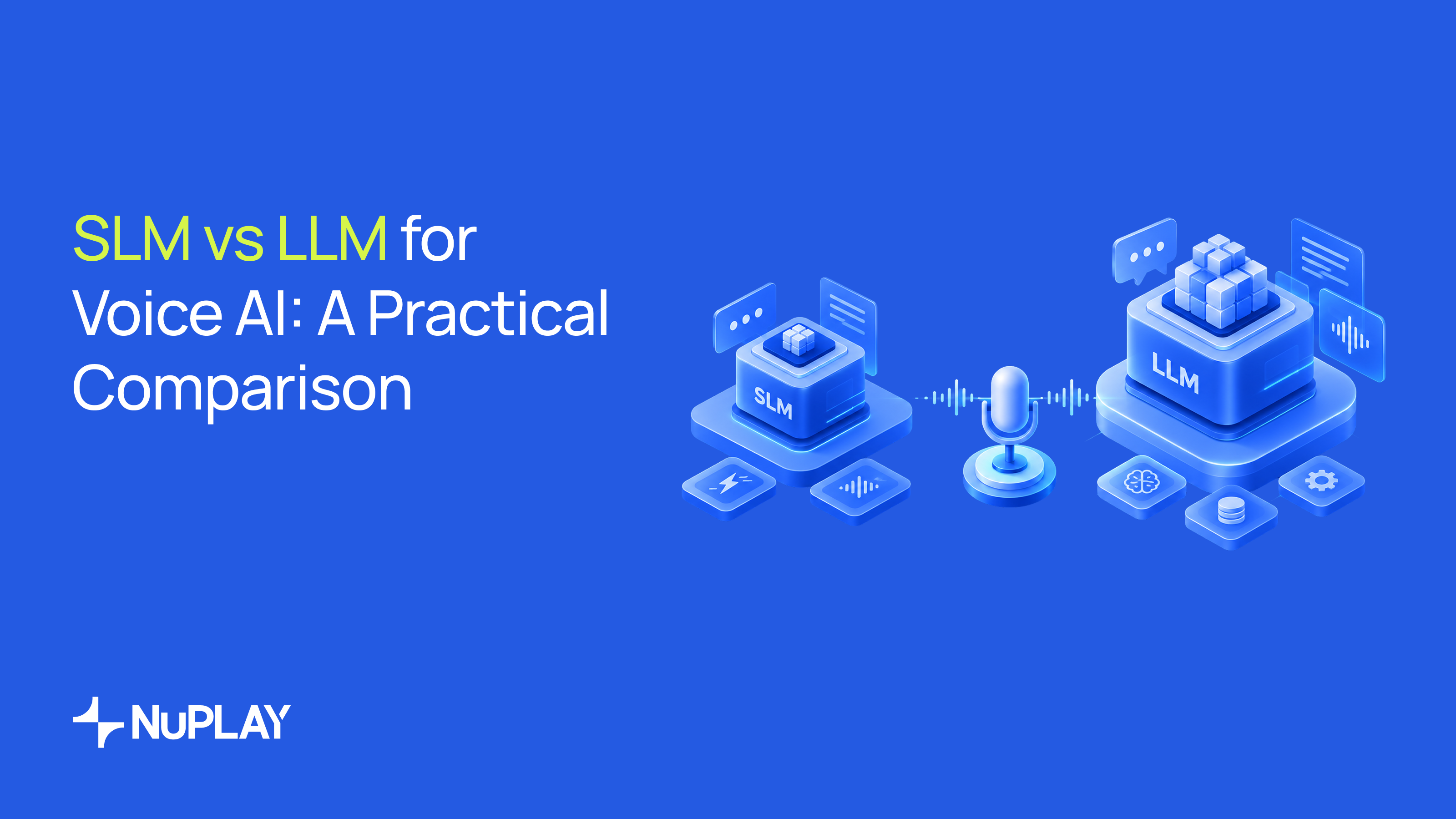

SLM vs LLM for voice AI: a practical comparison
A side-by-side look at where small and large language models each fit best in enterprise voice AI, and how Astra puts both to use.
Most enterprises building a voice agent make the same default choice: reach for the biggest, most capable model available, and route every single interaction through it. It feels like the safe option - more capability should mean fewer gaps.
In practice, it means paying for reasoning power you don't need, on interactions that never asked for it.
Quick definitions: SLM vs LLM
A large language model (LLM) is built for breadth - general knowledge, open-ended reasoning, the ability to respond to almost anything you ask for.
A small language model (SLM) is built for depth on a narrower set of tasks - fewer parameters, sharper focus, trained specifically on the kind of language and decisions a business actually deals with.
Same underlying technology. Different purposes. One is trained to know a little about everything; the other is trained to be excellent at a defined set of things.
The hidden cost of "one model for everything"
Here's what actually happens when every voice interaction runs through a model built for open-ended reasoning: the model pays a thinking tax on tasks that never needed that much thinking in the first place.
Confirming an order status and reasoning through a genuinely novel, ambiguous request aren't the same kind of problem. But route both through the same general-purpose model, and both get handled the same way - with the same overhead, the same latency, the same compute cost.
That overhead doesn't show up as one obvious failure. It shows up as calls that feel a half-second slower than they should, and infrastructure costs that scale in a way nobody can quite explain.
The mismatch, made concrete
A few examples of what most voice agents spend their time doing:
Checking an order status. This is a lookup with a known shape - get an identifier, retrieve a record, respond. It doesn't need a model capable of reasoning through an open-ended problem. It needs one that recognizes the request instantly and responds without hesitation.
Confirming a policy detail. "Can I return this after 30 days" has a defined, business-specific answer. A general-purpose model has to be prompted and guided toward the right answer every time. A model trained specifically on that business's policies already knows it.
Routing a call. Deciding whether a request needs a human, a specialist, or can be resolved on the spot is a fast, pattern-based decision - not a task that benefits from broad, general reasoning.
None of these needed the biggest model available. All of them got it, by default.
Why enterprises default to the biggest model anyway
The instinct makes sense on its face: more capability feels like fewer risks. If one model can theoretically handle anything, why build a system around several smaller ones?
The answer is in the call volume. Look at what an enterprise voice agent actually handles day to day, and the overwhelming majority isn't novel or open-ended - it's the same handful of intents and requests, repeated at scale. Defaulting to a model built for the rare, genuinely complex case means paying that cost on every single interaction, including the thousands that never needed it.
The better way to think about it
This isn't an either/or choice between SLM and LLM. It's a portfolio decision - matching the model to the task instead of running everything through one.
The high-volume, well-defined work - intent recognition, policy checks, routing, transactional lookups - is exactly what a small language model is built for. The genuinely open-ended cases, where broader reasoning is actually needed, are where a larger model earns its place.
Most mature enterprise AI setups end up here: a smaller, specialized model handling the bulk of the work, with a larger model as the fallback for what falls outside its scope - not one model trying to be everything to every call.
Where Astra by NuPlay fits
Astra is built around exactly this idea. Astra LLM and Astra SLM are two sizes of the same in-house, purpose-built family - not a single general-purpose model stretched to cover every case, but a model matched to the job in front of it.
The SLM handles the high-volume, well-defined work that makes up most of what a voice agent actually does. The LLM is there for what genuinely needs broader reasoning. Both fine-tuned for how your business talks to its customers, both running in-house.
The bottom line
Bigger isn't the same as better. Most of what a voice agent handles doesn't need a model built to reason about anything - it needs one built to handle exactly what it's being asked, quickly and consistently.
That's the case for rethinking "one model for everything," and it's the thinking behind Astra SLM and Astra LLM.