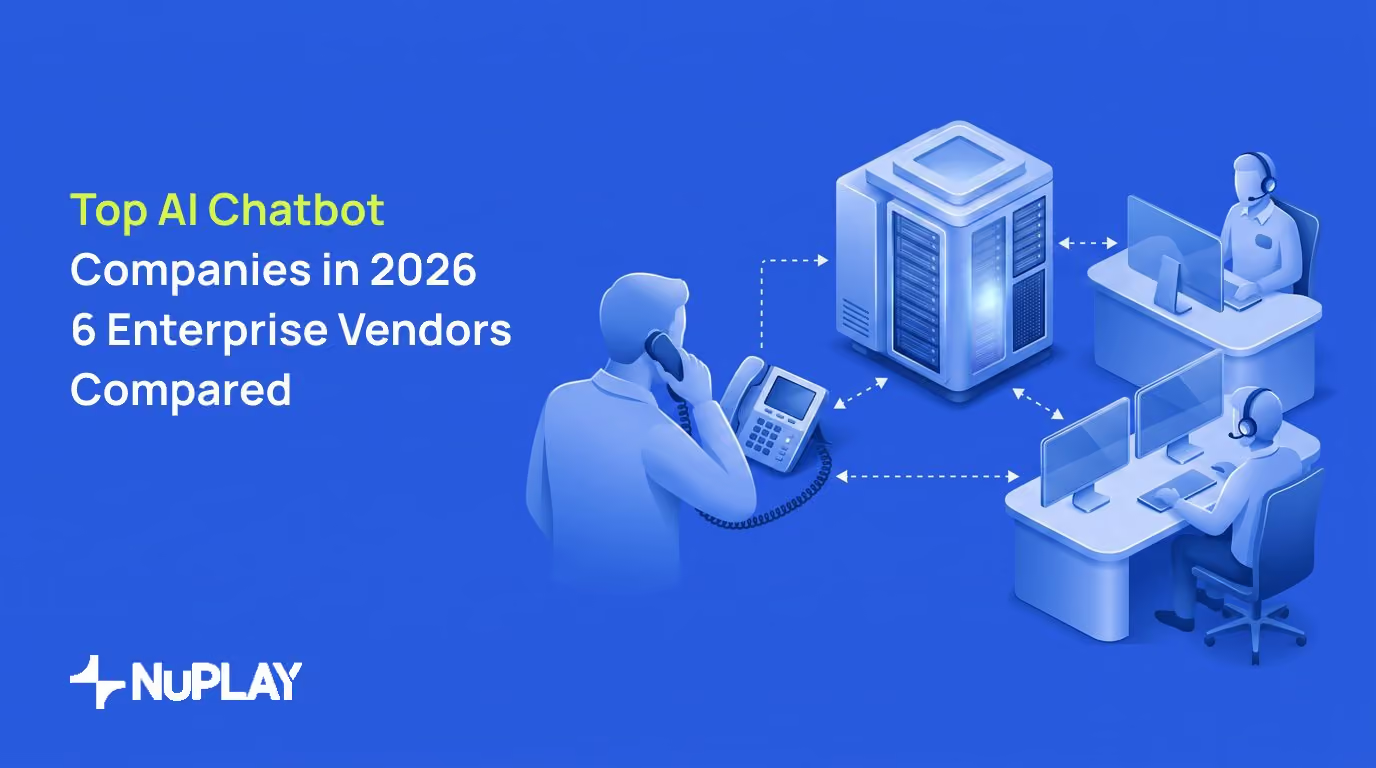
Top AI Chatbot Companies in 2026: 6 Enterprise Vendors Compared

Don’t miss what’s next in AI.
Subscribe for product updates, experiments, & success stories from the Nurix team.
The top AI chatbot companies for enterprise customer service in 2026 are Sierra, Decagon, Parloa, Intercom (Fin), Zendesk and Salesforce (Agentforce). All six now sell AI agents that resolve requests and act in backend systems, not scripted chatbots. They differ most on voice coverage, system access, governance and billing unit.
Disclosure: NuPlay AI builds a platform that competes with some of the vendors below. This is a review of public material: we read each vendor's own product, security and pricing pages on 27 October 2026 and did not run hands-on trials. Each vendor fact comes from that vendor's own site, and findings are labelled documented or vendor claim.
Gartner predicts that by 2029 agentic AI will autonomously resolve 80% of common customer service issues without human intervention. Picking a vendor is now a decision about which workflows you trust an agent to run, not which chat widget looks best.
What is an AI chatbot company?
An AI chatbot company builds software that answers customer questions and completes tasks in conversation using large language models (LLMs). In 2026 the leading vendors sell AI agents: software that reads your policies, connects to your systems of record and resolves a request end to end, handing off to a person when it should.
How we chose these AI chatbot companies. We started from the questions buyers ask AI assistants. NuPlay AI tracks 13 prompts about enterprise chatbot vendors across five AI engines (ChatGPT, Claude, Perplexity, Google AI Mode and Google AI Overviews). Six vendors are named in those answers, appear in the searches the engines ran to build them, or are cited as sources, and each documents a customer service product on its own site: Sierra, Decagon, Parloa, Intercom, Zendesk and Salesforce. Vendors are listed in no order of preference.
This list covers platforms an enterprise licenses and runs. It does not cover chatbot development agencies, open-source frameworks or contact-center suites, which buyers also search for but which are a different purchase.
Top AI chatbot companies at a glance
The table compares the six platforms on the points enterprise buyers check first. Prices are as each vendor published them on 27 October 2026, and "not published" means the vendor's own site lists no rate.
The six AI chatbot companies reviewed
Each profile below lists channels, backend actions, governance, security and pricing as the vendor documents them.
1. Sierra
Sierra describes itself as "the leading conversational AI platform for businesses" and says 40% of the Fortune 50 partner with it (vendor claim, sierra.ai/product).
- Channels: one agent across chat, SMS, WhatsApp, email and voice, and Sierra agents can also run inside ChatGPT through MCP. Voice handles inbound and outbound calls and card and ACH payments (documented, sierra.ai/product/voice). Voice supports over 55 languages.
- Actions: connects to systems of record to complete tasks such as returning an order, with 40+ pre-built integrations and custom ones.
- Governance: auto-generated simulations on every build, review and approval before changes ship, and supervisory layers around the LLMs.
- Security: Sierra lists SOC 2, HIPAA, GDPR, PCI, FedRAMP High, CCPA, CSA STAR, ISO 27001 and ISO 42001 as commitments, and states that it holds PCI DSS Level 1 Service Provider certification (documented, sierra.ai/product/trust-and-reliability).
- Pricing: no published rates. Sierra uses outcome-based pricing, where "you pay only when the software achieves specific, valuable outcomes".
Best for: large enterprises in regulated, transaction-heavy industries that want one agent across voice and digital channels and prefer to pay per outcome. For a head-to-head read, see our Sierra vs Decagon buyer's guide.
2. Decagon
Decagon positions itself as "the AI concierge for every customer" (decagon.ai).
- Channels: chat, voice and email in one layer. Chat covers web, SMS and WhatsApp. Voice runs on Decagon's own speech model, supports 70+ languages and includes outbound calling (documented, decagon.ai/product/voice).
- Actions: pre-built connectors, APIs and MCP support for data, actions and escalations. Agent behavior is written as Agent Operating Procedures (AOPs) in natural language.
- Governance: simulations before production and on every update, continuous integration testing, and a supervisor model that checks responses before they are sent.
- Security: zero data retention with AI model providers, AES-256 encryption, single sign-on and role-based access control. The security page lists SOC 2 Type II, ISO 27001, PCI DSS, HIPAA, GDPR, CCPA and EU AI Act badges (documented, decagon.ai/security); request the audit reports.
- Pricing: no published rates. A December 2024 Decagon blog post describes per-conversation and per-resolution options and says most customers choose per-conversation (Decagon blog); confirm current terms.
Best for: digital-first consumer and fintech brands that want customer experience and operations teams, not only engineers, to own the agent's logic. See the Sierra vs Decagon buyer's guide for a direct comparison.
3. Parloa
Parloa's page title reads "AI Agents for Enterprise Customer Service", and the site describes voice and chat on one platform (parloa.com).
- Channels: voice and chat, in over 140 languages and variants, with a chat widget that lets customers switch from typing to talking. Inbound and outbound calling are both documented (documented, parloa.com/platform/conversation-infrastructure). We found no email, SMS or WhatsApp channel.
- Actions: 50+ native integrations, APIs and MCP.
- Governance: simulations and evaluations covering every intent, tool call and handoff before go-live, with generated tests held in draft until a person reviews them.
- Security: Parloa lists ISO 27001, SOC 2 Type 1 and 2, PCI DSS, HIPAA, DORA, GDPR and the EU AI Act, with regional data residency through Parloa Zones (documented, parloa.com/platform/enterprise-security-governance).
- Pricing: rates not published. Parloa charges per minute for voice and per interaction for chat, with outcome-based pricing available, and says its billing "doesn't force the agent to protect a containment or resolution metric" (parloa.com/platform/pricing).
Best for: enterprises running large voice contact centers, especially in Europe and regulated sectors, that need data residency and many languages. For a deeper look, read our Parloa review.
4. Intercom (Fin)
Intercom is a customer service helpdesk; Fin is its AI agent, which also runs on top of other helpdesks (fin.ai). Intercom reports average resolution rates of 76% across 12,000+ customers (vendor claim).
- Channels: chat, email, voice, Slack, social, and messaging apps including WhatsApp, SMS and Instagram. Voice connects to existing telephony (documented, fin.ai/channels).
- Actions: takes actions through APIs, data connectors or MCP, and runs multi-step procedures.
- Governance: hands off to a person when a procedure is configured to.
- Security: SOC 2 Type II and ISO 27001, with ISO 42001, ISO 27701, HIPAA and AIUC-1 listed, and data hosting in the US, EU or Australia (documented, intercom.com/security).
- Pricing (observed 27 October 2026): 9.99. A conversation simply passed to your team without an outcome is not billed. Voice is offered on a custom plan through sales. On another helpdesk there is a 50-outcomes-per-month minimum; on Intercom's own helpdesk, seats start at $19 per seat per month (fin.ai/pricing).
Best for: teams that want a published per-outcome price and fast setup, including teams that keep another helpdesk. See our analysis of Intercom Fin for enterprise support.
5. Zendesk (AI agents)
Zendesk is a customer service helpdesk with AI agents built in, described as "self-improving AI agents built for resolution" (zendesk.com).
- Channels: messaging across web, mobile and social channels, email, and voice. Zendesk's help center announced that voice AI agents became generally available in September 2026 after an early access program that began in February 2026; they require Zendesk voice, are not available with Talk Partner Edition, and multi-language voice is still early access (documented, Zendesk help center). It supports 80 languages.
- Actions: an action builder and an API integration builder connect AI agents to other systems (documented in the help center); procedures are written in natural language.
- Governance: policies, behavior review and built-in quality assurance, with a quality assurance add-on for evaluating AI agent conversations.
- Security: SOC 2 Type II, ISO 27001, ISO 42001 and FedRAMP (low impact), with HIPAA support through a business associate agreement, and data centers in the US, Australia, Japan and the European Economic Area (documented, zendesk.com/trust-center).
- Pricing (observed 27 October 2026): AI agents are billed by resolution against a per-agent allowance. Seats run US55 and US2.00 each pay-as-you-go. Zendesk's help center says assisted-escalation and contained-resolution tiers do not count against the allowance. Voice adds telephony charges with no published rates (zendesk.com/pricing).
Best for: teams already on Zendesk that want AI agents bundled with the helpdesk. Read what Zendesk AI agents resolve and whether to replace or layer an AI agent on Zendesk.
6. Salesforce (Agentforce)
Salesforce is a CRM and system of record; Agentforce adds AI agents that act on Salesforce records and flows (salesforce.com/agentforce).
- Channels: the service agent deploys across voice, web, portals, SMS and WhatsApp (documented, salesforce.com/service/ai).
- Actions: pre-built actions such as scheduling and order management, plus a low-code Agent Builder using Flows, Prompts, Apex and MuleSoft, and MCP support.
- Governance: escalation that passes full customer context to the service team, Agentforce Guardrails and testing in Agent Builder. Salesforce says the service agent is protected by the Einstein Trust Layer.
- Security: Salesforce publishes certifications in separate trust and compliance documents that we could not load from the Agentforce pages; check them for the services you will use.
- Pricing (observed 27 October 2026): 500 per 100,000 credits (20 credits, about 0.15, per voice action), or per-user licensing at 550 per user per month and include 2.75 million Flex Credits per org per year (salesforce.com/agentforce/pricing).
Best for: organizations already on Salesforce Service Cloud that want agents working directly on CRM records. Read Agentforce limitations and alternatives, what Agentforce resolution costs mean, and how Agentforce Voice compares with a purpose-built voice agent.
What these platforms cost at volume
Three vendors publish usage rates, and each charges for something different. The table estimates monthly cost for 1,000 conversations, assuming every conversation ends in a billable outcome or resolution, text channels only, using each vendor's own published prices on 27 October 2026.
On these assumptions the published rates imply roughly 2,450 a month for 1,000 billable conversations. The Zendesk figure is an upper bound because Zendesk does not publish committed-tier rates. Salesforce Flex Credits would price per action instead, and Salesforce does not publish how many actions a conversation uses, so no estimate is possible on that model. Voice excludes telephony and other usage charges for every vendor.
The billing unit changes behavior. Per-outcome and per-resolution pricing rewards containment, while per-conversation and per-minute pricing charges whether or not the agent resolves the request.
How to choose among AI chatbot companies
Start from the workflow you want resolved, then test each vendor against these questions:
- Can it complete the task, not only answer? Ask which systems the agent writes to and how each action is logged.
- Which channels do you need on day one? Voice is the widest gap: check whether it is generally available, early access, custom-priced or sold separately.
- How does handoff work? The agent should pass full context to a person and should not be rewarded for avoiding escalation. See how human handoff preserves context.
- Who changes the agent, and how is a change tested? Look for simulations against real past conversations and human approval before a change ships.
- What will it cost at your volume? Model seats and usage together, in the unit you report on.
- Does it meet your compliance needs? Confirm certifications from the vendor's own trust documents, not a reseller or review site. See our due-diligence guide to buying AI agents under SOC 2, HIPAA and bank security review.
For the wider decision between an AI-native agent and one bolted onto a helpdesk, read AI-native vs AI-enabled customer service and our ranked shortlist of enterprise AI agent platforms. For how containment works at enterprise scale, read AI customer service agents and containment.
Where NuPlay AI fits
NuPlay is not a chatbot vendor. It runs the customer service workflow behind the conversation: NuPro agents handle the interaction by voice or chat, NuStack makes the systems they act on agent-ready, and NuContext supplies the customer's history. NuPlay AIruns enterprise workflows in production and improves them after every run through NuLoop, with agents, the systems they operate, and the context they draw on under one platform.
Changes follow a fixed cycle (Report, Diagnose, Propose, Try, Ship) and are tested against real past runs, and a person approves every change before it ships. Published results on NuPlay AI's success stories page include:
- Myntra: a 50% reduction in average handle time, with support scaled 3x without added headcount (case study)
- Cult.fit: a 95% issue resolution rate
- International Cricket Council: 100,000+ conversations in 5 days
NuPlay AI maintains SOC 2 Type 2 and ISO 27001 certifications and supports HIPAA and GDPR compliance requirements. To see how it resolves customer requests across your systems, explore customer resolution or book a demo.

Don’t miss what’s next in AI.
Subscribe for product updates, experiments, & success stories from the Nurix team.